


It usually starts with something small. The calendar, the dishwasher, whose turn it was to call the school. Then the voices tighten. Nobody is yelling, exactly (you are both being very, very careful not to yell), but the temperature in the kitchen has dropped about ten degrees.
And then a kid appears in the doorway, suddenly very thirsty. Or the TV in the next room gets louder. Or your youngest launches into a long, loud story about a dog he saw at school, right in the middle of the kitchen, and doesn't stop until somebody laughs.
Later, once things have cooled, the question arrives. How much of that did they take in? And did we just do some damage?
If that's your kitchen, you have a lot of company. It's a common worry, and one that's pretty well studied. Kids notice how heated it gets. What they're scanning for most is whether the family is still okay, and the ending is the part you have the most say over.
What kids are actually listening for
Start with the reassuring part. A 2002 research monograph on this exact question opens with it. "Witnessing conflict between parents is a normal part of family life for children, especially when conflict is broadly defined as any dispute, disagreement, or difference of opinion." Every family with more than one adult in it disagrees. That, by itself, isn't the problem.
What matters more is what the disagreement means to the child, and the same team set out to test that directly. In one study, 327 Welsh sixth graders watched videotaped arguments between adult actors. The researchers varied how the actors fought, from hostile looks and words to physical aggression to threats that the family might not stay together, and what they fought about. The children's reactions didn't simply track how aggressive things looked. Arguments that hinted the family might come apart upset them more than general hostility did. And for several kinds of fights, arguments about the child upset them more than arguments about adult business.
In the same study, as the fights moved from words toward physical aggression, children's fear rose, and their anger didn't. When asked what they would do, children said they'd step in or get away far more often than they said they'd copy the adults.
Which changes how the doorway looks. The sudden thirst, the louder TV, the dog story. Researchers have a name for those moves ("regulation of exposure to parent affect," which is a mouthful that means managing how much of the adults' upset you have to take in), and researchers read them as a security system doing its job. We read your child's move the same way: as a quick safety check on the family.
The same team followed 285 Welsh families over two years. Children who felt less secure about their parents' relationship showed more worry and sadness, and more acting out, two years later, even after accounting for how they'd been doing at the start. The conflict didn't predict those problems directly in that study. The link showed up by way of the children's sense of insecurity, a pattern that fits the idea without proving it. These were community families, mostly white and two-parent, with kids around 11 to 13, and most of the information came from parents' and children's own reports. Within those limits, our read is that what stays with a kid is less the argument itself than what it left them wondering about the family.
Quiet doesn't fool them
Here's where careful, loving parents tend to aim at the wrong thing. We assume the job is to keep it down. No yelling, no slammed doors, nothing a kid could repeat to a teacher.
Volume matters. But a major 2018 review of the field describes conflict between parents as running along a continuum "from silence to violence," and it sorts conflict by how often it happens, how intense it gets and how it's resolved. The frequent, intense and poorly resolved kind put children most at risk. The review counts the silent treatment, and hostility that never gets settled, among the destructive ways of handling conflict. Our read is that a house can be very quiet and still feel, to a child, like something is wrong.
It's fair to wonder whether this is really about the conflict, or about something families pass down in their genes. The review's authors looked at that. In studies built to pull the two apart, comparing twins, adopted children and their families, the links between parents' conflict and children's difficulties weren't fully explained by shared genes.
It shows up beyond mood, too. In the same review, that frequent, intense, poorly resolved kind of conflict went with more trouble sleeping, at school and with other kids, not only with mood and behavior, and children's sense of security about the family is one of the routes the authors trace it along. Most of the studies underneath are correlational, so this is a map of what travels together. We'd add one guess of our own. The kid who clowns and the kid who goes silent may be answering the same worry in different ways.
Two kinds of safe
You can be doing a lot right as a parent and still have this land on your kid.
In the family-wide part of the 2002 work, with 173 American middle schoolers and their mothers, conflict between the parents was tied to children's security about the parents' relationship. Parenting difficulties were tied to something different, children's security with the parent. Each kind of insecurity had its own pattern, too. Insecurity about the couple was most closely linked to worry and sadness, and insecurity with the parent to acting out. Warm bedtimes and patient homework help count for a great deal. In this work, though, parenting was tied to a different kind of security, which is why we don't think it can do the couple's work for the couple.
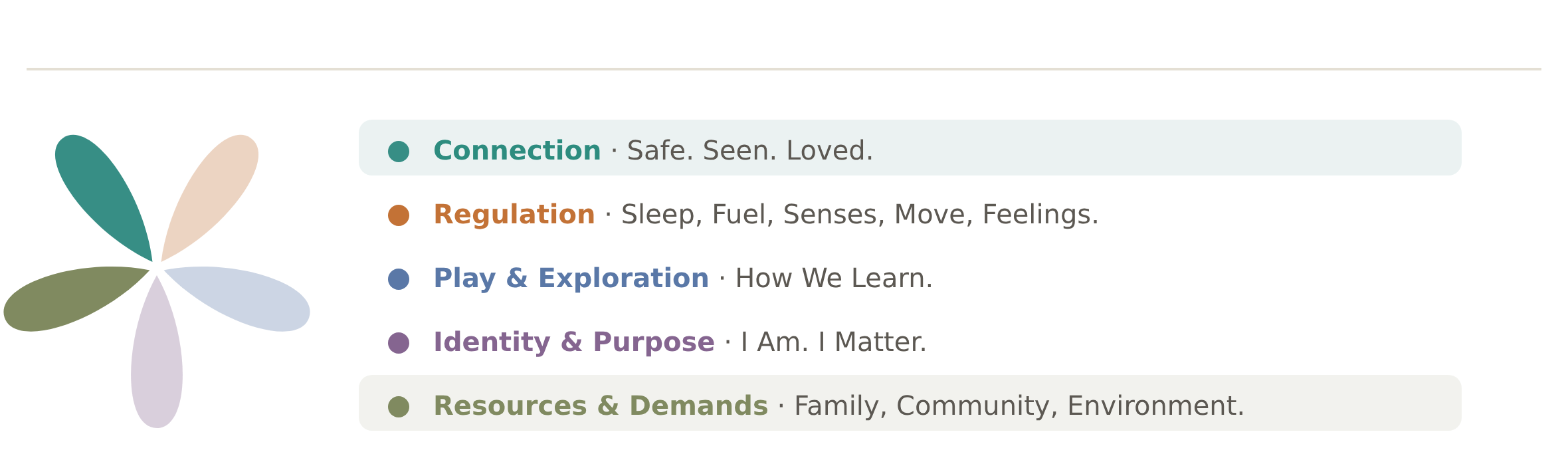
The same work found that the surrounding family turns the dial up or down. Where there was more instability, the same level of conflict was more closely tied to kids' insecurity. Where parents were more satisfied with their relationship and more open about feelings, and where the family felt close, the links weakened. That's a Resources and Demands story as much as a Connection one. The researchers argue that a child who keeps checking whether the family is okay is spending energy that would otherwise go to school, friends and play. Our way of putting it is that vigilance is expensive, and kids pay for it out of the same account they use for everything else.
When there are two households
When parents live apart, the conflict doesn't always go away. It moves to new places (handoffs, group texts, the school concert), and the research on separated families points to a related set of risks.
A 2020 meta-analysis pooled 115 samples, almost 25,000 families, all from divorced or separated families. Conflict between the parents traveled with children's difficulties partly by way of parenting, with less warmth and structure and more hostility. The single strongest link ran through what researchers call role diffusion, when a child gets pulled into an adult role as a parent's confidant or ally. The effects were small and most of the data captured a single moment in time, so this shows how things travel together, not what causes what.
In separated families, then, our read is that the pattern most worth watching is a child drafted into the adults' disagreement as a confidant or an ally. That research can't speak for families under one roof, but our guess is that the same pattern matters there too.
The part you get a say in
Back to the kitchen, and to the most hopeful line in the 2002 work. Looking at newer research on which kinds of conflict children experience as constructive and which as destructive, the authors noted that some conflict seems to pose no threat to children's security at all. "This message is a hopeful one," they wrote, "given that everyday conflicts are surely inevitable in close relationships."
The 2018 review counted how a fight gets resolved as one of the things that matter, and two small laboratory papers from the 1990s, with one of the researchers behind the 2002 work, tested endings directly. In the first paper, two experiments with 88 children aged 5 to 6 and 9 to 10 watched short videotaped arguments between adult actors that opened the same way and ended differently. The fight kept going, or the adults made up on screen, or they stepped out and came back friendly a few seconds later, or one of them explained that they'd apologized and worked it out offscreen. The fights left hanging stood apart. Children saw those adults as angrier and the problem as less settled, and they felt angrier themselves. The endings they could only infer, or only hear about, eased those reactions about as much as the one they watched. (That rests on small samples where the endings didn't measurably differ, which isn't proof they're equal. And after an explanation, the younger kids were less satisfied than the older ones, and children's urge to step in didn't clearly drop.)
The second paper, a single experiment with 98 children aged 5 to 7 and 9 to 12, kept the words of each ending the same and changed only the tone, the same apology said warmly or said angrily. Kids of both ages noticed the difference when they judged whether things had been worked out, and the older ones' own upset followed the tone. A fight that simply kept going read as unsettled whatever the tone. A pleasant voice didn't turn it into an ending. Both used actors rather than the children's parents and short clips (the second paper's arguments were deliberately mild), with mostly middle-class families (the second sample was entirely white). The offscreen break lasted seconds, not the hours a real argument can take, and both measured reactions in the moment, not how children did later.
One caution, so nobody reads this as a reason to pick more fights. None of this suggests kids need to see conflict, or that more of it toughens them up. The experiments speak to the ending, and the separated-families research adds keeping the child out of the middle. Our read puts the two together. Disagreement that's handled with warmth, keeps the child out of it, and gets brought to an ending the child knows about looks like something children can watch without losing their footing.
Everything here is about ordinary disagreement. If arguments in your house involve threats, or anyone is afraid of being hurt, that's a different situation, and the first step is getting support for the adults.
The kid in the doorway with the empty glass, we think, is asking a small question. Are we okay? You can't always choose how an argument starts. You have a lot of say in how it ends, and in whether they find out that it did.
Try This
Let Them See the Ending
If the kids saw or heard the argument, let them see the end of it too. That can be the two of you back at the table, an arm around a shoulder, an ordinary joke. It can be a sentence, said calmly, and by both of you if you can manage it. With younger kids especially, let them see it as well as hear it. "We got upset with each other about the schedule. We talked it through, and we're okay." Say that one only when it's true. If it isn't settled yet, say so. "We haven't sorted it out yet. We're working on it, and that's our job, not yours." If the argument was about them, add one more line. "Us arguing isn't your fault."
If you live in two households, add one more piece. Keep your child out of the content and out of the middle. Messages for the other parent go to the other parent. If you notice your child becoming your sounding board about their other parent, find another adult to play that role for you. This is our application of the research rather than a tested program, and none of it replaces getting help if things at home have tipped from disagreement into fear.
Consider This
What does my kid do when we argue?
Think about the last few times things got tense between the adults in your child's life. Did your child go quiet, get loud, get silly, get busy, vanish to their room, or try to referee? Whatever it was, try reading it as information rather than misbehavior. What was it protecting? And what would your child need to see from the adults, afterward, to be able to stand down?
Want the research behind this post? Read the Dive Deeper: How the Argument Ends -- the emotional security studies, the silence-to-violence review, the separated-families meta-analysis, and two laboratory papers on how arguments end, with limits noted.
Every Functional Child Development post comes with a Dive Deeper companion. Subscribe for the full picture.
The kid who's suddenly very thirsty in the doorway. I've seen that exact scene so many times. Kids learn how grown-ups disagree mostly from how we finish. A repair they can actually see, even a short "we talked it through, we're okay," teaches more than any talk about using kind words. You're the textbook whether you meant to be or not.