


You’re here because something about “Functional Child Development” caught you. Maybe the name. Maybe a post a friend forwarded. Maybe the quiet sense that the reactive way most of us were taught to think about kids isn’t quite working.
Here’s the premise. Most parenting advice waits. It waits for a milestone to be missed, a behavior to become a problem, a diagnosis to arrive. Then it scrambles.
We start from the other direction. What do kids actually need to develop well? Not in theory. In practice, in your home, starting tonight.
That’s what “functional” means. It comes from Functional Medicine, where the move is to build the conditions for health on purpose, not wait for things to break. The same logic works for raising kids. Don’t wait for the diagnosis. Build the conditions for thriving on purpose.
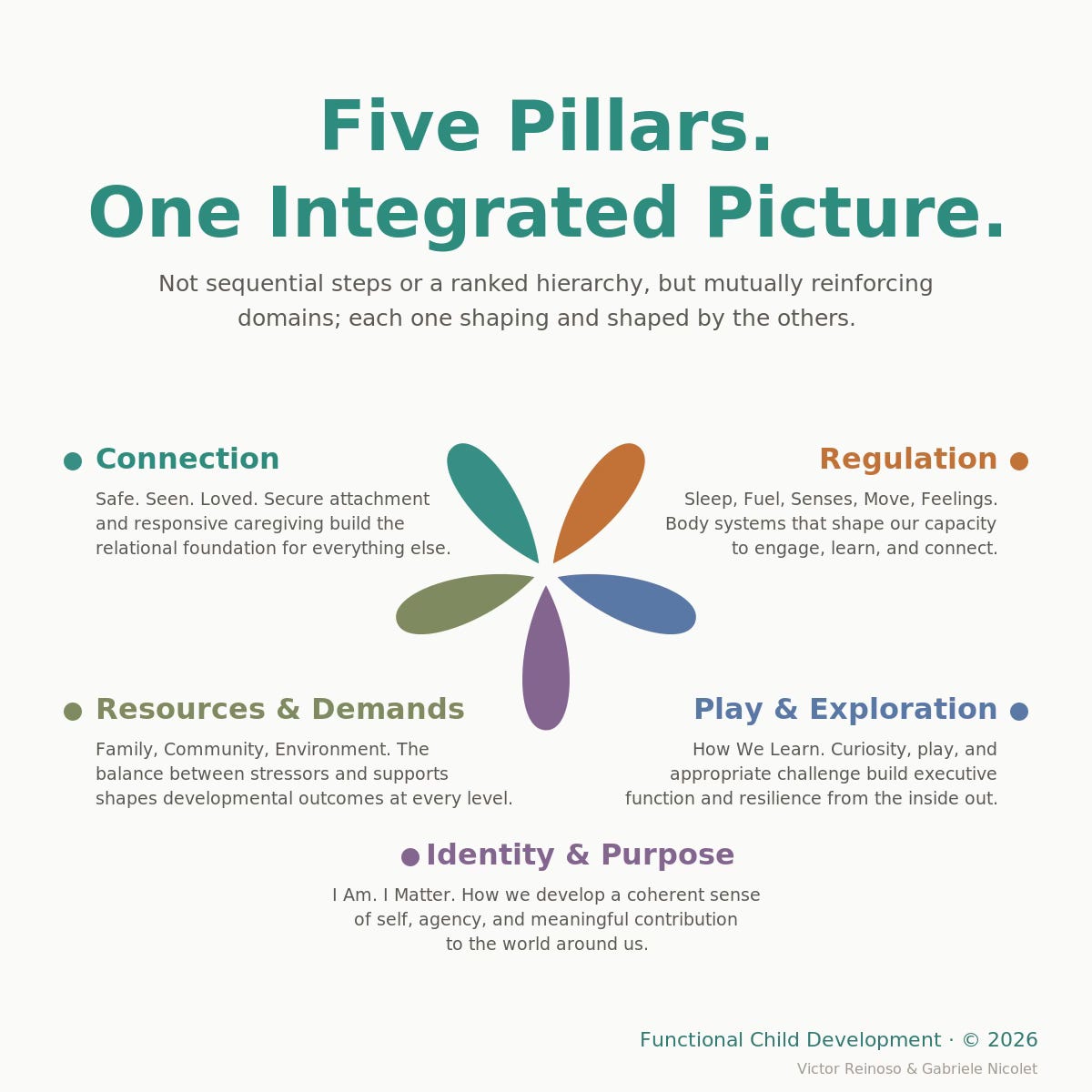
The five pillars
FCD organizes everything around five conditions that either hold or they don’t. When they hold, kids build the capacity to thrive in a world that keeps changing. When they don’t, behavior tells you exactly where the gap is, if you know how to read it.
Connection is the first. Safe, seen, loved. A child whose nervous system has a reliable place to land can do almost anything. A child without that spends the day in alarm, no matter how bright they are or how much you love them.
Regulation is next. Sleep, fuel, senses, move, feelings. The boring inputs underneath every meltdown and every shining moment. The 4 PM meltdown isn’t bad character. It’s biology asking for something.
Play and Exploration is how kids learn. Not the only way. The way. The brain organizes itself through play in ways no curriculum can substitute for. Adults forget this because we’ve been trained to think of play as the opposite of work. Kids know better.
Identity and Purpose is the pillar most parenting books skip. I am. I matter. The story a child builds about who they are and what they’re for becomes the architecture they spend the rest of their life decorating. We can help shape it on purpose, or we can leave it to chance.
Resources and Demands is the one nobody can opt out of. Family, community, environment. The container your kid develops inside. Not a thing you can fix in an evening. But a thing worth seeing clearly so you know what you’re up against and what you’re given.
How to read this newsletter
We publish two kinds of posts. The main posts apply the framework to a specific question, the kind that lands in your kitchen at 7 AM or 7 PM. The companion Dive Deeper posts show the studies underneath, and where the evidence is strong and where it isn’t.
You don’t have to read them in order. (You don’t have to read the Dive Deepers at all.) If you want a place to start, work the pillar that’s most pressing for your kid right now. If sleep and food are wobbly, start with Regulation. If your kid can’t find their feet socially, start with Connection. If you’re not sure, start with Connection. Most of it starts there.
Who this is for
We write for parents first. Educators, pediatricians, therapists, and anyone who works with kids will find their way in. We’re honest about the evidence: where it’s strong, where it’s thin, where parenting will always require judgment over certainty.
If you’re here, you’re already doing the harder work. You’re already paying attention. The science is just here to put words to what you’ve been noticing. You’ve got this.