The trees around us have started to look terrible.
Their leaves are turning, drying out, and letting go. Branches that were full in August will be bare by Thanksgiving. Flowers and fruit are gone. Visible growth has mostly stopped.
If you built a dashboard for a maple tree and compared October to July, nearly every indicator would be headed the wrong way.
Leaves: down.
Green: down.
Fruit: down.
Growth: down.
And nothing has gone wrong.
The tree is doing exactly what a healthy deciduous tree does. As the days shorten, it sheds leaves, pulls nutrients back into its branches, slows its activity, and prepares for winter. What looks like decline from the outside is the part of the cycle that lets it survive and grow again.
We’ve been thinking about this because of something a friend said to one of us recently about children and measurement.
We tend to assume that healthy development moves up and to the right. A child reads 40 words a minute, then 50, then 60. She tolerates ten minutes of homework, then twenty. Fewer meltdowns, less help, more friends, more independence. Whatever the measure, we expect the line to rise, and when it does not, we start looking for what went wrong.
Actual human development is stranger than that.
Sometimes children acquire a new ability and then appear to lose something they could previously do.
A young child may correctly say went, then later start saying goed. This sounds like a mistake, and technically it is. But it happens because the child has figured out something bigger. English verbs change to talk about the past. He is applying a new rule too broadly before learning how the rule and its exceptions fit together.
He knew the word. Then he learned the system. And for a while, learning more made his performance look worse.
Researchers have found a similar shape in mathematics. In one set of studies, seven-year-olds did better than nine-year-olds on certain mathematical-equivalence problems, and eleven-year-olds did better again. The researchers compared age groups rather than following the same children. Their explanation was that years of conventional arithmetic could make an unfamiliar equation harder to recognize. Experience that helps on one kind of problem can get in the way on another.
Development takes other shapes, too.
A long plateau followed by a leap.
A burst of new ability followed by instability.
Several strategies appearing at once before one becomes reliable.
A skill that works beautifully in one context and seems to disappear in another.
A child who suddenly needs more help with something she was doing independently six months ago.
Developmental scientists have documented stair steps, zigzags, reversals, U-shapes, and long stretches of high variability. The neat diagonal line captures only one possible shape of change.
When the demands move
This matters because childhood is full of transitions. Starting school, learning to read, changing classrooms, entering puberty, making more complicated friendships, moving from elementary to middle school, becoming more independent from parents while meeting demands much harder than the ones that came before. When the environment changes, yesterday’s competence may no longer be enough.
A child who could organize everything she needed for third grade may look suddenly disorganized in sixth, when there are seven teachers, long-term assignments, changing classrooms, extracurriculars, a phone, complicated friendships, and a brain in the middle of its own renovation.
Her executive function may not have gone backward.
The demands moved.
We see something similar in babies. A baby can become quite skilled at judging what is safe while crawling, then make surprisingly poor judgments when he begins walking. The earlier learning does not transfer, because walking is a different problem for the body. He has to learn again, with a new body, in a new position, under new conditions.
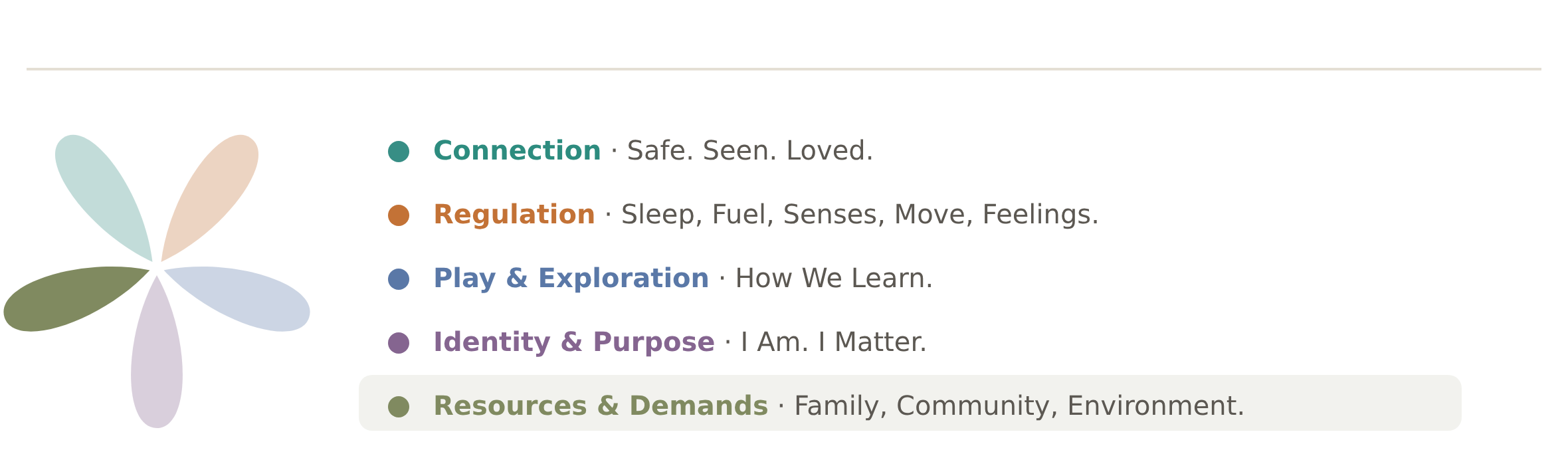
This is one reason we come back so often at Functional Child Development to Resources and Demands. When a child suddenly appears less capable, we can ask four questions. Did the child change? Did the demands change? Did the available resources change? Or is something new being built that has temporarily made the system less stable?
A loss of established language, motor abilities, social engagement, or daily living skills deserves prompt attention from your child’s clinician. Sudden changes in functioning can tell us that a child is overwhelmed, unwell, unsafe, sleep-deprived, depressed, anxious, or otherwise in need of support.
A step backward on the thing we are measuring tells us to look more closely. By itself, it does not tell us what is happening developmentally.
That is a harder idea to live with. Measurement gives us something comforting, a line. We can locate the child on it. We can compare this month with last month. We can decide whether things are moving in the right direction. But sometimes we are mistaking the shape of our measurement system for the shape of development itself.
Back to the trees
Soon they will be bare. If you had never seen autumn, you might reasonably conclude that something catastrophic had happened. But we know enough about trees not to make that mistake. We understand that there are seasons in which the visible signs of thriving disappear. We understand that a living system can change dramatically without moving steadily upward. We understand that conservation, reorganization, and waiting are sometimes what healthy development looks like.
We might extend children the same curiosity.
When something that seemed settled becomes messy again, we can ask both questions.
What might be changing here? and What’s gone wrong?
The real shift happens when we begin defaulting to the curiosity of the first over the judgment of the second.
Try This
Before You Draw the Line
The next time a score drops or homework becomes harder, run three checks. First, name what else changed. Same skill, same setting, same demand, or did the test move? Second, look for where the skill still appears. If it shows up at a grandparent’s house or on the soccer field, ask what makes using it easier there. Third, change one resource and look again. An earlier bedtime, a printed checklist on the fridge, ten fewer minutes of homework. Improvement gives you a clue about useful support, even if it does not explain the whole drop. If your child has lost an established skill, seek advice promptly rather than waiting to complete these checks.
Consider This
Think about the last time you watched a number go the wrong way on your child. Now think about what else was happening that month. The new school, the growth spurt, the friend group that rearranged itself, the sleep that slipped. The line was accurate. The question is what it was measuring.
If this post found you in the middle of something, tell us about it. Many of the posts here started exactly that way. We answer.
Want the research behind this post? Read the Dive Deeper: The Problem With Up and to the Right -- the daily-sampling study, the past-tense errors, the nine-year-old dip, and the crawl-to-walk reset, with limits noted.
Every Functional Child Development post comes with a Dive Deeper companion. Subscribe for the full picture.