We usually think of money, education, and opportunity as protective for children. And for the most part, they are. Every part of that picture is backed by hard evidence at the bottom of the range. As family resources increase, most risks decrease. Kids are healthier. School outcomes improve. Stress goes down. But something surprising happens at the very top.
Researchers who study students in high-achieving schools (the well-funded ones with the strong test scores and the elite college banners) kept finding rates of anxiety, depression, and substance use running well above national norms. Not slightly off-pattern. Off-pattern enough that national bodies reviewing the evidence on adolescent wellbeing began listing youth in high-achieving schools among the groups at elevated risk, alongside categories nobody argues about, like kids in poverty and kids in foster care.
Sit with the strangeness of that sentence. In other words, some of the communities we assume are safest for kids can also be places where kids struggle the most.
The Hidden Costs of Affluence
Nothing about a comfortable house harms a child. The problem is not affluence itself. The problem is what often comes with it.
Two things show up again and again. The first is achievement pressure. There is always another grade, another team, another lesson, another audition, another achievement to chase. Love may not actually depend on performance, but children can begin to feel as though it does. The second is that the adults are often stretched thin. The same professional intensity that creates opportunity can consume the people providing it. More work. More stress. Less emotional bandwidth. Put those together and you can end up with a child whose material needs are fully met while two developmental essentials become scarce: unconditional connection and adults with enough capacity left at the end of the day to provide it.
The research on parental burnout points the same direction from another angle. When investigators looked at what predicts a parent hitting empty (exhaustion, emotional distance, the feeling of just going through the motions), income and education barely mattered. What mattered was the balance of demands against resources, family disorganization, and perfectionism. Read that list twice. Perfectionism and overscheduling are not rare in high-achieving communities. They're often part of everyday life.
Different Circumstances, Similar Mechanism
The strongest effects of money on child development are found among families who have the least of it, and we know this from studies that come remarkably close to establishing cause and effect. When tax-credit expansions put roughly a thousand extra dollars a year into low-income families' hands during a child's adolescence, graduation and college completion rose, measurably. When a tribal casino began unconditional payments to families in a long-running study, poor children's behavioral problems fell to the level of their never-poor peers. A dollar at the bottom of the gradient does real developmental work. The same dollar at the top does almost nothing, because nothing was missing that dollars fix.
This post isn't saying the loads are equivalent. A family choosing between rent and the electric bill isn't carrying the same weight as a family choosing between two travel teams, and pretending otherwise would insult one family without helping the other. The challenges are not equivalent. But they do share something important. In both situations, children are living inside a family system carrying a great deal of stress. The source of that stress may be different. Poverty can create it. Achievement culture can create it. Chronic exhaustion can create it. Children still experience the downstream effects of overwhelmed adults. The circumstances are different. The effect on family capacity can be surprisingly similar.
If You're Raising Kids in a High-Achieving Environment
Here is the part for the parent reading this in the nice kitchen, feeling something they haven't had permission to name.
You have probably been told, or told yourself, that your family has nothing to complain about. Your kid hears a version of it too. You have every advantage, what's there to be anxious about? That way of thinking focuses on visible advantages while ignoring the pressures a child may be carrying.
Children do not experience their lives as a collection of advantages. They experience them as a collection of daily demands.
An anxious, sleepless, perfectionistic twelve-year-old isn't ungrateful. She's responding, accurately, to the conditions she's developing inside. And if she's a kid who runs sensitive or is wired differently, the same pressure lands twice as hard.
You don't fix this by liquidating the college fund or pretending your family has fewer opportunities. You fix it the way families recover from overload. Ask less. Connect more. Put the adults back within reach. That's household work, not policy work. And it starts with admitting that your family can be genuinely fortunate and genuinely overwhelmed at the same time. You're allowed to take the second one seriously.
Try This
Take Stock of Your Child's Week
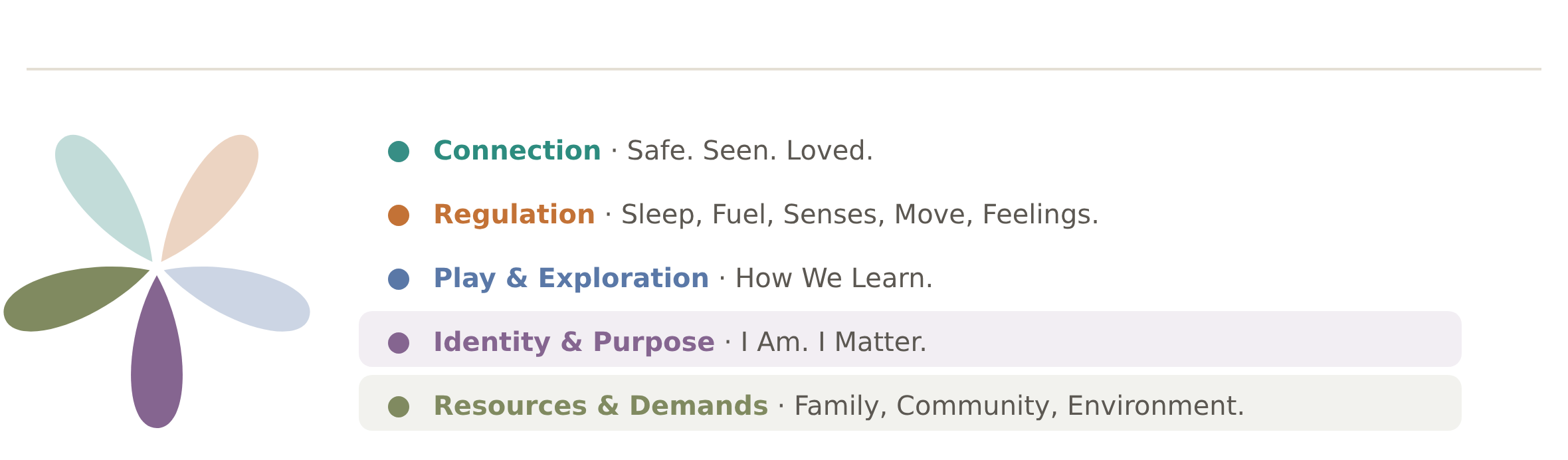
This week, take one page and make two columns. In the first column, write down everything your child's week asks of them (Demands). School. Homework. Practices. Tutoring. Auditions. Competitions. The quiet demands count too, like conversations about college or worries about disappointing adults. In the second column, list the Resources your child actually experiences. Sleep. Downtime. Unstructured hours. Meals with adults who are fully present. Time with someone who has genuine attention to give.
Then make two changes for next week. Retire one demand (an activity, an expectation, a recurring conversation) and say why out loud: "You don't need one more thing to be good at." Add one resource from the child-facing column, and protect it like a commitment, because it is one.
Consider This
When your child succeeds at something, what happens in your house in the next ten minutes? And when they fail?
Pay attention to whether warmth, attention, and emotional availability increase after success and quietly fade after disappointment. Children notice those patterns with remarkable precision. If the answer stings a little, don't treat it as a verdict. Treat it as information. Families can change.
We write about parenting and developmental science at Functional Child Development.
Want the research behind this post? Read the Dive Deeper: When Advantage Becomes Pressure -- the affluence research, the tax-credit and casino natural experiments, and the burnout evidence, with limits noted.
Every Functional Child Development post comes with a Dive Deeper companion. Subscribe for the full picture.